Resonance Before Reason
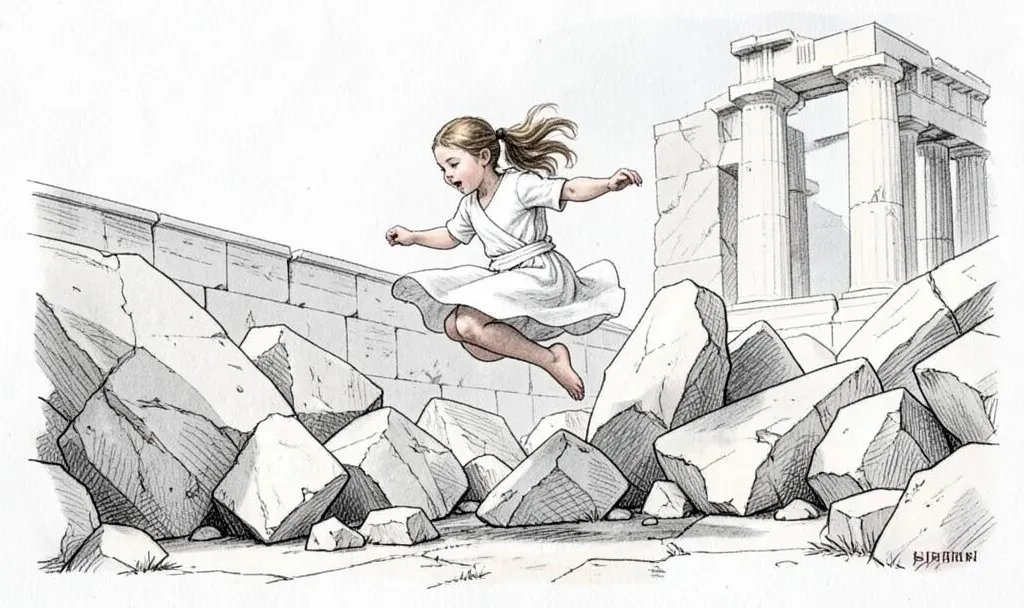
Resonance, the second pillar. A drawing of a child on the Acropolis: how an arriving signal wakes what a life has laid down, feeling first and reasons after, and how the same mechanism couples one mind to another.
My wife showed me a drawing the other day — a new sketch of our daughter. She had made it from memory, from an afternoon on the Acropolis more than a decade ago, when our girl was small: a child in a white robe, caught mid-leap over the fallen stones, hem and hair lifting, the broken marble bright behind her. I looked at it, and something in me went still and then full. Before I could have told you why — before I had assembled a single reason — the whole afternoon was back: the heat coming off the stone, her fearlessness, the particular moment of that day, and the ten years that have passed over it since. The feeling arrived first. The explaining, such as it was, came limping along behind.
That gap — feeling first, reasons later, if at all — is what I want to describe, because the drawing did not inform me of anything. I was there; I have no new facts to learn about that afternoon. What the image did was reach into everything I had accumulated and set a part of it ringing. A life lays itself down as structure — a vast synaptic matrix built from everything you have seen and loved and suffered — and the signal that reaches you is never raw. By the time an image arrives at the eye it has already been shaped by every prior looking; it lands as a kind of conditioned fragment, and that fragment goes looking through the matrix for its match. Where it finds one, that patch of you lights up, wakes its neighbours, and the whole settles toward something familiar. That lighting-up is what I mean by resonance. None of this is only a figure of speech. It is close to what neuroscience now takes recognition to be — an incoming signal, already shaped by expectation before it lands, completing itself against the pattern stored in you. That completion is achieved by complex methods, between the accumulated matrix and the arriving fragment, that researchers are only beginning to map — pattern completion, they call it — and it is far more involved than a tidy word like resonance lets on. The felt event is simple; what achieves it is not.
There is nothing mystical in it. A tuning fork will sing when its note is played across the room — not because anything travelled between them, but because the shape was already there to be woken. Minds do the same, only with unimaginably more shapes, and far more at once. You do not decide to be moved. You are moved, and then, if you are the reflecting kind, you go looking for the reasons.
And you are rarely moved by a single note. Resonance is chordal: one signal wakes many patterns together, some consonant, some in tension, the whole irreducible to any one of them. It is why the drawing did not land as one clear feeling. In the same instant it carried the joy of that bright afternoon and the quiet ache that the child in the white robe is grown now, and the day long gone — two notes sounded at once, a single complicated chord. Most of what we feel is chordal in this way. It is why the truest feelings are the hardest to name: they were never a single tone.
The reasons, when we reach for them, almost always arrive after the fact. Robert Pirsig spent a whole book circling this and called it Quality — the recognition that something is right that comes before, and beneath, any analysis of why. A radiologist I know says a scan will light up for him a beat before he can name what he has seen; a good mechanic hears the fault before he can say which part is failing. Their gift is not that they reason faster. It is that more of the world resonates in them, so the recognition comes first and the explanation second. We are all experts in this sense about the things we have lived: they resonate before we can speak.
This is old machinery — far older than us. Resonance runs in anything that has accumulated a past and can be woken by the present; a dog lights up at the sight of its lead long before it has a word for the walk. It is older than language, older than music, as old as nervous systems able to hold patterns and wake them to a signal. What came later — music, then language, then ideas themselves — did not invent resonance. They gave it new kinds of things to touch: a melody that finds the shape grief has left in you, an argument that suddenly clicks because it fits a pattern you were already holding without knowing it. The mechanism is ancient; only its materials keep growing richer.
A word, since it has been used elsewhere. The sociologist Hartmut Rosa has built a rich body of work around “resonance,” where it names a responsive, mutually enlivening relationship between a person and the world — something to be cultivated, and good. What I mean is more elementary and more neutral: the bare mechanism by which anything touches anything at all. It sits upstream of good and bad. The same process that lifts a congregation to its feet lifts a crowd at a rally; the chord that moves you in a cathedral can be sounded, note for note, by something you would rather not be moved by. Resonance does not vet what it carries. It only asks whether the shape fits.
That neutrality is exactly why it matters, because resonance turns out to be how the deepest things pass between us. We like to imagine culture is transmitted by instruction — pushed, taught, handed down in lessons. A little of it is. But the parts that truly last are not pushed; they are pulled — drawn into minds already, for reasons no one arranged, prepared to receive them. A song outlives its moment because it keeps finding listeners shaped to need it. An old idea can lie dormant for centuries and then catch like dry grass when a generation arrives that resonates with it. Nothing was transmitted by force. The receivers were ready, and the signal found them.
There is a modest freedom in this. You cannot choose, in the instant, what will move you — the recognition is faster than the will. But you have some say over what you set in front of yourself, and over what you return to, because repetition deepens the groove. What you let resonate, you strengthen; what you strengthen, you grow more able to feel. Attention, given again and again to something worth it, slowly tunes you toward it — less a trick for manufacturing feeling than the old idea of cultivation: you tend what you wish to grow, and in time you resonate more readily, and more finely, with it.
And here is the part I find most astonishing. The same can happen in many people at once. Sit the right few hundred in a theatre and let one line land, and you can feel the whole house go still together — separate lives, separate accumulations, moved by the same signal in the same instant and, for a moment, resonating as one. It is what fills a rock concert, or a stand at a thrilling match when the crowd comes to its feet before anyone has decided to. That the same lighting-up can leap a room and couple strangers into something briefly single is, to me, among the most remarkable things we have learned about how we work as a group. We are instruments that can be tuned to one another.
Which is, in the end, what resonance is for. It couples us — to one another, to the places we have been, and to the people we have lost. Love is its deepest amplitude: to love someone is to have been so deeply touched by them that they sound inside you whether they are present or not. Grief is the same string still ringing after the source has gone — which is why a dead parent’s handwriting, or a child’s outgrown shoe, can undo you across years and distance. My daughter is grown now, and that particular child in the white robe exists only where my wife and I have kept her: in two separate accumulations of one bright afternoon, which a few lines on a page were able to sound at once. Nothing supernatural in that. Only the ordinary, astonishing fact that we are bells built to be rung — and that the things we have loved go on sounding in us, long after the afternoon is over.
Note on method. The ideas here are mine, and have been the subject of a human quest you can follow at www.integraloflife.com. As an engineer I am comfortable having them written with an LLM in support, as much as you presumably are about the software that helped design the aircraft you fly in.