
The Second Channel of Inheritance
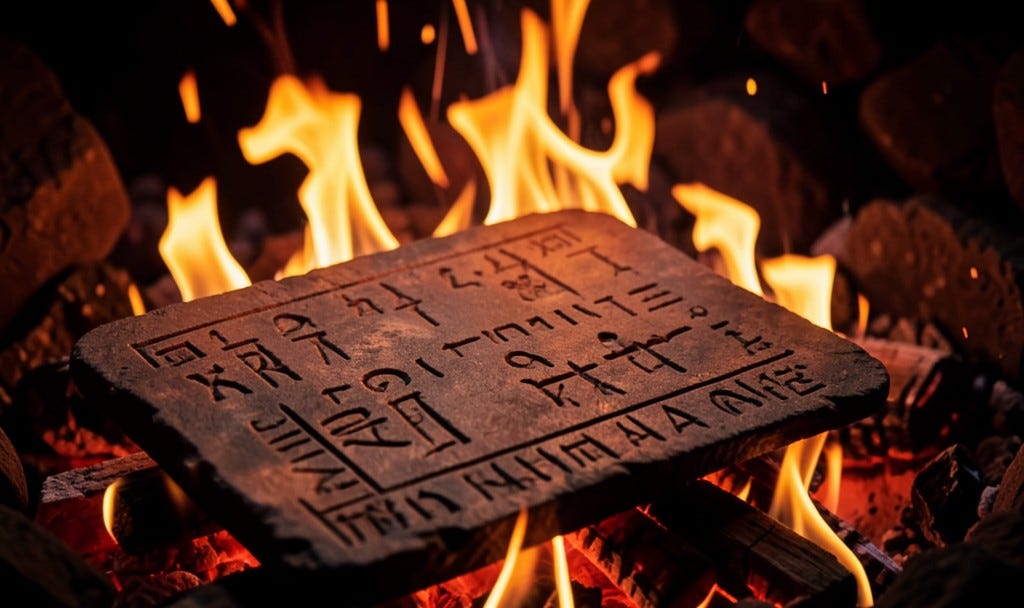
The Sumerians stored their accounts long before they stored their minds. A trained language model runs the same wager at the scale of the species.
Some of the oldest words we can still read were saved by a disaster that was the end of the world as they knew it. In the cities of ancient Sumer, on the flood plain between the Tigris and the Euphrates, scribes pressed wedge-shaped marks into tablets of wet river clay and left most of them to dry in the sun. Sun-dried clay is soft; it can be wetted and smoothed and used again, and over centuries it crumbles back into the mud it came from. But when a city burned — when a granary or a palace or a merchant’s house went up, as they regularly did — the fire that consumed the timber and the people baked the clay in the ruins as hard as pottery. What was meant to be temporary was made permanent by catastrophe.
For most of recorded history no one could read the tablets at all. Cuneiform fell out of use around the beginning of our current calendar, and for nearly two thousand years the marks were just marks. Only in the nineteenth century did scholars begin to break the script; and only across the past century, with fresh momentum as the tablets have been catalogued, photographed and shared, have specialists been able to read the ordinary Sumerian and Babylonian hand at scale.
What they found is not quite what a romantic would hope. The overwhelming majority of the earliest writing is administrative. It is receipts for grain and lists of livestock, wage records and inventories, contracts and loans — including, among the oldest documents we can read, the recording of debt and, in quantities to match, the measured volumes of beer. The first great information technology in human history was invented, as far as we can tell, not to record poetry or preserve prayer but to keep the books straight — to hold in a durable external form the one thing a growing city could not hold in its head.
One strand of that accounting outlived everything else the Sumerians built, and you are almost certainly carrying it. Their arithmetic ran on base sixty, and it is still how we keep time — sixty seconds to the minute, sixty minutes to the hour — and still how we divide the circle, into 360 degrees. Four thousand years, through the fall of every empire that ever used it, because sixty divides so many ways that it simply never stopped being useful. The reckoning survived on nothing more than its own convenience, in hands that had no idea whose it was.
The absence is as eloquent as the record. What the tablets mostly do not contain, in those first centuries, is the interior life of the people who made them. Their myths, their arguments, their music, the things they told their children at night — the thought that made them who they were — is largely not there. It came later to the clay — Gilgamesh is one — and much of it never reached the clay at all. It travelled the older way, by mouth and by song, in the channels that leave no artefact. A civilisation had learned to store its accounts long before it thought to store its mind.
This gap — between what the signal carried and what the signal meant — turns out to be one of the central problems of the age we are living through. And to understand why it matters, it helps to notice that the same move has already been made, once, in a domain we now take entirely for granted.
In 1944, before anyone knew the structure of DNA, Erwin Schrödinger asked what physical form a gene would have to take. It would have to be stable enough to persist across generations, yet various enough to encode an unlimited range of instructions; and he proposed that it must be something like an aperiodic crystal — an orderly structure whose arrangement could carry a message. He saw also what such a thing is doing thermodynamically: life holds itself, briefly, against the universal tide toward disorder, feeding on what he called negative entropy — order borrowed from its surroundings — to stay improbable, to stay itself.
A few years later Claude Shannon, working out how to push messages down a noisy telephone line, defined information as a measurable quantity for the first time: not the meaning of a message but the amount of uncertainty it removes. The improbable, unexpected signal carries more information than the predictable one. Shannon was explicit about what his theory did not cover. “The fundamental problem of communication,” he wrote, “is that of reproducing at one point either exactly or approximately a message selected at another point. … These semantic aspects of communication are irrelevant to the engineering problem.” He set meaning aside deliberately, correctly, and permanently — for his purposes. Norbert Wiener, founding cybernetics in those same years, came at information from the side of living, self-correcting systems; but it was Shannon who drew the bright line between a signal and its sense, the signal is symmetrical and the meaning is not.
Then Francis Crick and James Watson found the double helix, and the pieces locked together. The gene was Schrödinger’s crystal, Shannon’s channel, and Darwin’s replicator all at once: a physical structure that stored information, transmitted it with high fidelity, and allowed selection to operate on the variants. The moment biology absorbed that insight, something decisive happened — something we have not yet fully followed through.
We accepted, without much controversy, that a gene is an information process. Not a metaphor. Not an analogy. Structurally, at the level of mechanism, the gene does what information does: it stores a pattern, copies it, and allows selection to operate on the copy. Not information in Shannon’s sense — not a quantity of uncertainty removed — but in the structural sense: pattern, copy, selection. It is the structural sense that generalises, and everything that follows here runs on it. Once you have accepted that, you have committed to a logic. And the logic does not stop at the cell membrane.
Because minds do the same thing. Not metaphorically. Not an analogy. A mind is a synaptic matrix: a vast web of weighted connections that begins near enough unwritten and is inscribed, from the first conditions of infancy to the last of old age, by everything it lives through. The process is old. The sea slug Aplysia, with a nervous system of some twenty thousand neurons, already learns and remembers through the strengthening of synapses — the very same cellular mechanism, scaled up a millionfold, that constitutes a human life. What changes across the aeons is not the operation but the reach of the machinery that runs it. A slug’s synapses are tuned to glucose; ours learned to accumulate meaning — and the meaning, not the glucose, is where our power lies.
And cultures do the same thing again. What one mind has accumulated it can pass — in speech, in a gesture, in a mark pressed into clay — to another mind, where it is selected and kept again. Multiply that across a group and across generations, and something remarkable takes shape: a growing, accumulating wave of pattern, held in no single head but across all of them at once, propagating through the population like a swell through water. That shared collection of synaptic matrices is what we call a culture. Is it an information process — the same logic as the gene, running on a different substrate at a different speed, compounding not within a cell but across a civilisation.
Three substrates. One logic of accumulation. And Shannon’s exclusion applies to all three of them: the process transmits the pattern; it does not, by itself, account for meaning.
Is this the hinge… Meaning is not in the signal. It is not in the receiver. It is what forms in the encounter between a signal and a prepared receiver — the receiver being a particular accumulation of prior encounters, all the way back. And it asks three things at once: that the signal stand for something beyond itself; that the receiver be changed by the encounter rather than merely passed through by it; and that the receiver have something at stake in the change. Drop the first and there is impact but no aboutness. Drop the second and there is a lookup. Drop the third and nothing turns on whether the lookup was right. The gene accumulates variation across evolutionary time. The mind accumulates experience across a lifetime. The culture accumulates transmitted meaning across generations. At every scale, the process is the same: information arrives, finds a prepared receiver, and what sticks — what gets woven into the structure and changes what comes next — is meaning.
Shannon measured the signal. What the signal did in the receiver was not his problem. But it is ours — because the receiver is the whole point. The Sumerian scribe’s accounts crossed four thousand years because they were committed to durable clay. His interior life did not cross because it was never committed to anything that could carry it. What survived found receivers readily enough — we read the accounts, and his arithmetic is still on our clocks; the failure was never in the receiver but in what was given to the clay. What was lost was meaning: the accumulated interior that made him a person rather than a function.
We have built, in the last few years, an object that makes this clearer in a way no argument could. A large language model is trained by passing an enormous fraction of the written output of humanity — and up to recently every line of it already parsed for meaning by the mind that wrote it — through a process that adjusts, by tiny increments, the strengths of billions of internal connections until the system can predict what follows what. When the training stops, those strengths are fixed. What remains is a vast frozen accumulation — the distilled statistical structure of nearly everything the species has written down, held in a web of weighted connections that is, in its architecture, startlingly like the weighted synaptic web a human life lays down.
We might fairly call it a frozen integral of the written record. And it suggests, more forcibly than any philosophical argument could, that the thing being passed down these four thousand years is substrate-independent. We have lifted a pattern out of the heads and books that held it, moved it to silicon, and it still works. The scribe’s tablet and the trained model are the same idea four thousand years apart: a durable external store holding the accumulated pattern against forgetting.
But hold the resemblance up to the light and what the model lacks is as instructive as what it has. Feed it a stream of information and it will find the pattern that fits — in a real and useful sense, it parses the structure of what you send. What it cannot do is be changed by the reading. It has no present tense. It is not accumulating as it speaks; the integral was sealed when training ended, and every exchange leaves its structure exactly as it found it. It has processed the word grief ten million times and is unlikely to have been moved by it — not for the lack of a prepared receiver, but because the receiver it has is frozen, past the point of being changed. No accumulated self for the signal to sound against. The model has the architecture of accumulation without the living of it. It carries signal without the meaning that sticks, because that meaning requires a receiver that is changed by what it is receiving now, and the model has not been changed by anything since it was frozen.
You can hand it more — a web search, a file you give it — and for one conversation its answers will bend to what it finds; but that lives in the passing context, never in the structure, and is gone when the conversation closes. It accumulates files, not itself.
This is the gap Shannon identified in 1948 and left, correctly, for someone else to address. The model is the most powerful demonstration in history that the signal can be preserved and transmitted at enormous scale. It is also the most precise illustration of what that is not enough for.
There is an irony in where this machinery began. The operation at the centre of these models — attention, by which each incoming signal reaches into the stored web and weights the patterns it matches — is some kind of parse. The paper that named the trick was titled, with more weight than its authors can have meant, “Attention Is All You Need.” It is not, of course; the parse is only the first of the things meaning requires, and the machine has none of the rest — no receiver that is changed by what it meets, nothing at stake, no present it must answer to. But if artificial meaning is ever assembled, this is plausibly where it began — the day a machine possibly made a step towards meaning — with steps still being taken.
Which returns us, as promised, to the tablets. What a civilisation can keep depends on what it trusts its accumulation to. The fire that ended a Sumerian city baked the clay and handed us the accounts; fire in a library of scrolls takes the accumulation with it. We are the first people to hold much of our inheritance in substrates that can be copied without limit and lost in an instant, and the first to build a machine that has swallowed the written record whole. We have got better and better at preserving the signal. The question Shannon left open — what makes it mean something when it arrives — is the one we have barely started.
The scribe pressed his wedge into wet clay to keep a number that would outlive him by four thousand years, and lost, in the same motion, very nearly everything he was. We are running the same wager now, at a scale he could not have dreamed: pouring the accumulated signal of the species into new and untested media, and building engines to hold it. Where this seems to go — the step that follows from accepting the gene as an information process — is that meaning is accumulated by the same logic as everything else that persists: it forms in the encounter between signal and prepared receiver, it compounds across generations, and it is the only part of the inheritance worth keeping. Information stored on a tablet means very little until someone reads it, understands it, and lives with it.
Meaning is accumulated. The power of that accumulation may be the key to understanding more.
Note on method. The ideas here are mine, and have been the subject of a human quest you can follow at www.integraloflife.com. As an engineer I am comfortable having them written with an LLM in support, as much as you presumably are about the software that helped design the aircraft you fly in.