
The Lived Mind Resonates
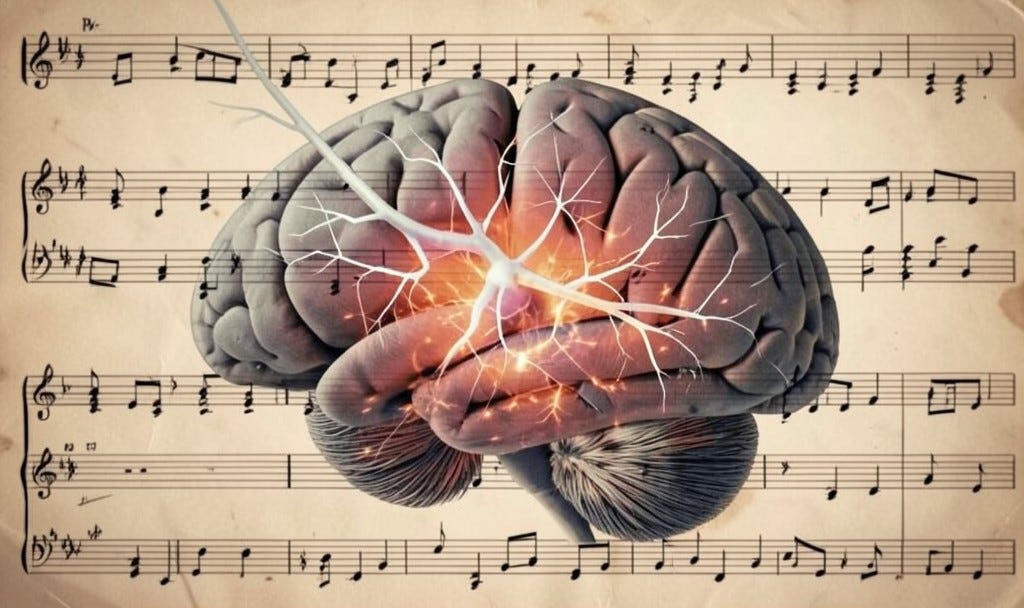
Hopfield networks, predictive coding and the frequency domain: how a mind accumulates, resonates and imagines, and why a language model does not.
In the beginning of this account, a man theorised how something akin to a mass of neurons — a mind, or near enough — might actually work. It was 1982. He treated a network of neurons as a physical system with an energy, a landscape of hills and valleys, and remembering became a rolling-downhill problem. A partial cue puts the system on a slope somewhere; the dynamics carry it to the nearest valley floor; what comes out is the pattern the valley was shaped by. Retrieval became descent. John Hopfield published that in a short paper, and in doing so handed the study of memory to people who had never studied it.
Physicists could work on this, and did, quickly. Within three years the statistical mechanics of it was exact; within a decade the same picture had been mapped onto the hippocampus, where it is still the leading account of how episodic memory works. The associative net had been in Nature since the late sixties, but 1982 is when it acquired an organising idea, a following, and a name.
Then, from a different direction and largely out of earshot, came an account in which cortex guesses the world. It compares its guess with what arrives and passes on only the difference. An iterative technique, and a Bayesian reading of it. Karl Friston turned that from a cortical mechanism into a general theory of self-organising things. Andy Clark carried it into philosophy of mind. The textbooks came later, and then all at once. Perception became prediction, corrected.
By then there were two vocabularies. One camp said attractor, basin, energy landscape, connectome. The other said prediction error, precision, generative model, free energy. The evidence looked different too. The first had ring attractors demonstrated in behaving fruit flies, and attractor states pushed about with optogenetics in mouse cortex: causal work at the level of circuits. The second had human neuroimaging, with blood oxygen levels as a proxy for activity, plus psychophysics and phenotypes drawn from clinical work: correlational, and heavy on model-fitting. Two lineages, with two styles of proof.
The obvious reading is that one camp was winning, and counted by the eponym it was: the Bayesian literature outweighs the Hopfield literature by something like nine to one. But that ratio is measuring a surname. Counted instead by the words the substrate people actually publish under — connectome, connectivity matrix, attractor network, eigenmode, energy landscape — the gap closes to somewhere near parity, and the substrate side led for most of the last decade. The name had left and the tradition had stayed. "Hopfield network" was inherited by an engineering literature about neuron-like circuits and image encryption. It copies the wiring and asks nothing about minds. Meanwhile the mind-science work quietly renamed itself and carried on. Bayes won the branding. The volume was a draw.
Then there is the growth. Across 2006 to 2025 the two literatures expanded by factors of 5.32 and 5.44, the same to within a few per cent, while sharing almost no words. Rivals do not behave like that. Rival answers to one question produce displacement: attention and money follow the apparent winner, and one programme grows at the other’s expense. Complementary answers to different questions grow together, each fed by its own problems. Equal, sustained growth in two camps with no shared lexicon is what a division of labour looks like from outside the room.
And since about 2021 the punchline has been arriving. A 2023 paper showed that temporal predictive coding can be viewed, in its simplest form, as a classical asymmetric Hopfield network: both are members of one larger family. A survey published this year holds every one of those pieces in a single document, and declines to weld them. Two bodies of ideas grew at the same rate for twenty years. They competed for the same students and the same money, and collaborated without meaning to. Now they are demonstrably inside one mathematics, and still the words have not crossed.
They stayed apart while looking at the same thing. There is one hippocampus, and both camps have an account of what it is doing. Memory, perception, decision, confidence and the persistence of a state across a gap in the input are one subject matter. The camps partitioned the same system differently, and a partition is invisible from inside it. Take the energy function as given and ask what is being minimised over. Hopfield descent minimises over states. The coupling matrix is held fixed while the system settles, and the dynamics are a ball rolling on a surface whose shape is already set. Predictive-coding descent minimises over states and parameters both, because prediction error focuses on the current estimate and, less so, on the accumulated model that produced the expectation. Same functional form, different cut between what moves and what stays still. Roughly, one keeps the running total and the other works on the difference.
Look at that for a moment as something that happened to people. Some thousands of intelligent people, working on one organ, in one century, with overlapping funding and adjacent conference hotels, and for the better part of twenty years almost nothing passed between them. Nobody was wrong, and nobody was hiding anything. They had no shared words, so there was nothing for an arriving idea to land on. Two accumulations of knowledge, each one’s foreground the other’s furniture, growing at the same rate with intent and no agreed destination. That destination is what the rest of this essay is about, and it is easier to see and feel within ourselves than in a field survey.
There are two gaps. The first is a gap between the theories and arguably the anatomy, and the improving mathematics is dealing with it. The second runs between everything either camp measures and the scale at which a life is actually lived, and no theorem is going to close it.
The second is a gap in altitude. Both camps work on the connectome, a network of neurons described over milliseconds to hours. A life is decades long and made of things like a job taken, a person met, a war, a book read at nineteen. But the connectome is where a life accumulates; experience changes synapses, and synapses are what a connectome is. What is missing is the mathematics for it, which lags a long way behind how it actually works. So what follows is a description offered at the higher altitude, extended from the two camps to a scale neither works at.
So here is the proposal, at that altitude. Keep four words in mind: three pillars, accumulation, resonance and imagination, and a thread running through them, meaning.
Our synaptic matrices are each an accumulation over experience and choices. In their simplest Hebbian form they are literally a sum, and nobody in either camp has much occasion to ask what such a sum comes to after forty years. Scale the question up and the claim is that a self is the accumulation, across a life, of some function of what a person chose and what happened to them. It is discounted by a decay that is not constant. It can be written as an integral, and it is worth writing that way. The function inside it is unknown and may stay that way. What gives the claim its shape is our own experience of it: differential weighting, uneven decay, dependence on prior accumulation, and early input counting for disproportionately more.
On a mesoscale that matrix is neurons and their synaptic connections, and the mathematics is not in there with them. A Hopfield network is a way to understand neurons and synapses. The maths here is the silhouette of an evolved and lumpy substrate. The description works at one altitude — above the synapse, below the whole of history — and it earns its place there or nowhere. And that altitude happens to be where meaning lives. Synapses do not have meanings. Neither do centuries.
We each experience the accumulation as a memory of patterns and weightings. Individually we experience that as a child, through school and education, through our lives and relationships. We learn as we live. Most of what arrives fades, and fast. What stays does not stay at random, and the rates vary in ways ordinary enough to check against a life. Trauma runs at close to zero decay. A high-amplitude event that could not be processed when it arrived keeps its weight for decades, and shapes the handling of everything after it. Anything integrated while the structure was still being set is written deeper for the same input, which is why the years between thirteen and twenty-two cost so much and pay for so long. And rehearsal resets the clock, which is why liturgy, daily practice and a standing lunch with old friends work as technologies.
None of which is stored. Nothing is filed and nothing is retrieved on request, which is why most of what an accumulation contains is unavailable to the person carrying it around. The accumulation is what a mind is made of. The gap between holding something and being made of it is most of the distance between a memory and an architecture.
There is a reason any of this means anything to the thing doing it. We parse the incoming information stream for meaning, compare it with our life experience, and act accordingly to protect our stake in life. A living system holds itself together against the gradient that runs every other physical system down. It pays for that all the time, in energy taken in and disorder sent out. Every record that stays written was paid for somewhere. A structure that must keep paying to persist has a sense of better and worse, and it needs no mind to have one. Some states help it continue; others do not. That is where meaning comes in, and meaning is what the accumulation is made of. Information reads the same whichever way it runs. Meaning depends on who is reading, and what it cost them to become that reader. The constraint binds in aggregate, over many lives. The consequence lands on one person, at the decision. Stakes are what negentropy buys.
That accumulation is shared, within families and among peers, and across generations. Our synaptic matrices at birth are much like those our near ancestors were endowed with. What has ratcheted up is what is already built and waiting for them: the language, the music, the institutions, the record. Each generation ratchets up in ability by accumulating on top of the accumulation, and takes most of it early, when the decay rate is lowest. Much as the two schools of mind were doing earlier.
An accumulation on its own describes one mind in a room by itself, though, and two minds need a second idea. Nothing crosses between them. What travels is a carrier: a sound, a mark, a phrase, a look. What counts happens on arrival, inside a structure that is already a matrix of everything it has integrated. The arriving signal activates what is already there. A synaptic matrix fragment lights up, recruits its neighbours, and the system settles toward something familiar. That is the whole of it, and it happens inside one head; when it looks social, the social part is downstream. Call that internal process resonance: it is what happens when a song moves you, an idea lands, or you find you are tuned to a language.
Resonance has two conditions, and confusing them is easy. For a signal to land at all there has to be enough overlap between what arrives and what is already accumulated. That is why a joke dies in the wrong room, why the like-minded find each other so reliably, and why an idea can sit in a library for four centuries and then be received in an afternoon. But for the landing to yield anything there has to be enough non-overlap, because you cannot resonate with your own echo. Overlap is the condition of contact; difference is the condition of yield.
What arrives is already shaped. The eye delivers a signal formed by everything prior looking has taught it, and the ear delivers something already filtered through language and music and memory. Anil Seth’s phrase for the result is controlled hallucination. Clark’s formulation is tighter: to perceive is to meet the sensory signal with an apt stream of multiple predictions. His demonstration is better than either. Play a familiar melody with one note left out and the listener supplies it. They generate the note.
Then there is what the matrix itself is like. Biological synapses run one way, so the coupling matrix is asymmetric. The symmetric version that made Hopfield’s mathematics tractable was always the convenient case. An asymmetric matrix has complex eigenvalues, and complex eigenvalues mean its modes oscillate. Oscillation and phase are the ordinary physics of a nervous system, and complex numbers are simply the mathematics of anything that oscillates with a phase. So once cortex is shown to run on lawful rhythm — theta and gamma, cross-frequency coupling, travelling waves — the complex-valued description follows as description, on exactly the footing the matrix already stands on. It is no more a claim than the matrix is. Engineers meet this every working day. When a system takes in signal over time and has a frequency response, as brains appear to, the useful move is to stop watching it tick and look at it in the frequency domain. There what it holds shows up as modes, each with a strength and a phase. Read that way, a matrix stores resonances, and what arrives either finds one or it does not. The description also earns its keep where it can be tested. A vision group built a network carrying amplitude and phase separately, and it beat both its real-valued twin and the same network with the phases frozen.
The same physics marks the line between a mind and the machines now most often compared with one. Peter Godfrey-Smith, who came to minds through the octopus, draws the same line. A nervous system, he says, has two sides, the network and the rhythm, and only the network is easy to put into a computer; the rhythm would need a very different kind of machine. A trained language model accumulates in a mathematically similar way: its weights are a sum over everything it has read, and it can be queried as one. But a digital network is an emulation, a matrix written as numbers and executed as lines of code. However many threads it is spread across, the multiplication is still worked through row by row, one step after another; the whole matrix never acts at once. Nothing in it oscillates and nothing runs out of phase. It integrates. It does not resonate. That puts a question mark over the substrate independence now widely assumed for AI, the idea that a mind is the computation and the hardware incidental. If the rhythm is part of what a mind does, the substrate is part of the mind. And because nothing it says alters the weights that said it, being wrong costs it nothing; whatever stake there is belongs to whoever runs it.
Our minds are carrying out similar synaptic processes in one go, continuously, and that brings in dynamics. A mode with a complex eigenvalue behaves like a flag on a pole in a breeze: held at one end, never still, its shape at any instant set jointly by what is arriving and by what the flag is made of. Neither term is inert. Work published in Science Advances last year has the incoming signal reweighting the matrix itself according to how far it overlaps with each stored pattern: the matching valley deepens, and the state runs to it from almost anywhere. The accumulation recognises itself in the input. So recognition changes what it recognises. Whatever the signal wakes, it also reshapes. Every act of resonance is a small act of accumulation, and what is recalled is slightly different from what was there before the recall.
Music is the clean case and the oldest one. Locking onto a shared beat and holding it with other people is the earliest coupling technology there is, older than language by a long way and present in every culture anyone has looked at. When people move to one rhythm their neural states converge; Uri Hasson’s group has shown that the degree of synchrony between a speaker and a listener predicts how well the communication actually worked. The shiver at a particular chord is the felt end of it: a configuration in the signal aligning with configurations in the structure at several levels at once.
Language, on this account, was selected because it upgraded the accumulating function itself. Three consequences compounded on each other. The dead could teach the living. Propositions could be combined into configurations nobody had ever encountered — hypotheticals, counterfactuals, instructions for situations not yet faced. And a claim could be examined and revised before it was passed on, which is where philosophy and law and science come from. Every accumulation that outlasts the people who made it follows from that one upgrade.
Resonance is morally blank, and that has to be said plainly. The same architecture fires when the first chords ring out at a concert and when a crowd rises at a rally. The judgement is real and it is made afterwards, about what the coupling built or destroyed. Anyone who wants resonance to be a good thing will have to argue for it separately, and the argument will not come from the mechanism.
The third part of this, imagination, is the least settled, and it runs longest here for that reason. In Clark’s account, imagination is the same predictive apparatus running when little or nothing is arriving to correct it: the model free-running, decoupled from the senses, generating the world it expects. Friston’s active inference sits underneath, supplying the moment-to-moment rule by which the gap between prediction and arrival gets closed. It is a clean idea and a powerful one, and it puts imagining and perceiving on one continuum, which was overdue.
It also does not match how it feels. I ride a fair distance most weeks, and there is something that happens on a long road I cannot make fit the offline account. The surface is being read continuously: camber, loose gravel, the air off a passing truck, the bicycle’s own endless small corrections, all of it arriving and being acted on inside a second. And the whole time something else is running: a conversation not yet had, a paragraph being turned over, a shape being tried and discarded. It runs alongside the road, and both at full strength. When the front wheel finds a pothole, the second stream does not have to be switched off, because it was never switched in.
So the proposal is that imagination runs coupled to perception: a second stream, extra dimensions in the synaptic matrix, out of phase with the sensory present but locked to it, and adjustable in the mix. More of the real when you are threading a river crossing, more of the other when you are looking out of a train window. Some people can move that ratio a long way and some cannot move it much at all, and the variation is one of the more interesting things about people.
The mechanism is already sitting in the paragraphs above, which is the attractive part of it. The modes of an oscillating matrix carry phase, and there are more of them than the senses are using at any moment. What the spare ones carry stands out of phase with what is arriving. It is all the one matrix. Nothing has to be computed separately and nothing has to be switched over: an out-of-phase axis is what an oscillatory accumulator produces. That counts for more than it sounds, because a genuine moment-to-moment simulation engine (generating and evaluating futures continuously across every sensory channel at once) would be extraordinarily expensive, and the organ under discussion runs on about twenty watts.
Here is the seam, stated plainly, because it should not be crossed without one. The dynamics hand you two components. They do not hand you the claim that one of them carries the imagined. That identification, that imagination is what accumulates on the out-of-phase axis, is a proposal. It is mine, and it is the part of this that could turn out to be simply wrong while everything above it stayed standing.
What is not speculative is the coupling. Nadine Dijkstra and colleagues reported in Neuron last year that imagined and perceived content are intermixed in the same perceptual substrate. They are told apart by the strength of the activity they generate, with a frontal network reading out the verdict. So the fact that people sometimes cannot tell the difference stops being a puzzle. It is what you would predict of a single architecture. Recording from inside human heads, Proix and colleagues found overt speech decoding best from high-frequency activity, while imagined speech is carried by low-frequency power and local cross-frequency dynamics: a different phase signature for the imagined thing, in the same substrate. Accumulated over a life, the two are laid down together, in the same matrix, at the same time, and it becomes virtually impossible to tell accumulated reality from accumulated imagination.
Our minds accumulate over a lifetime, in a synaptic matrix. Incoming conditioned sensory signals, in the form of matrix fragments, resonate, and that is how we share experiences with one another or within groups. They resonate because the matrix is asymmetric: its eigenvalues are complex, its modes oscillate, and recognition is a match found in the frequency domain. And that same mechanism leaves reality and imagination coupled, accumulating in a variable way. A digital network can copy the accumulation, but nothing in it oscillates, so it never resonates. That’s the idea.
And it can be tested. Three prohibitions, offered and not scored. Show that an experience integrated at fifteen decays at the same rate as the same experience integrated at fifty, with rehearsal and emotional weighting matched. Show that the ease of coupling between two minds is unrelated to the distance between what they have accumulated, so that failure sits in one party alone. Find an institution that went on working after every person who held it had gone, with nothing transmitted to those who came next. None of these is settled here.
Which leaves culture, the third scale. After a field and a person, it is everybody at once. It is the largest thing human beings have built out of nothing at all, and it accumulates the way the other two do: nobody owns it, nobody made it on purpose, and nobody has finished it. From little things big things grow. Money and religion are two of what it has produced.
Money accumulates: the oldest money is credit rather than coin, and a coin is trust externalised into metal, layer on layer, none of the value present in the paper or the digit. It resonates: it lets people who will never meet act as one, at scales no personal relationship could reach. And it is imagined, entirely and at the centre — which is easiest to see on the days it stops, when a currency’s holders all update at once and the soap on the shelf is still soap while the money in the hand is not. Most of us seem to accept this shared fiction.
Religion is the same three, run deeper. It accumulated across millennia, refined empirically for what worked by people under no obligation to know why it worked. It resonates at more levels simultaneously than anything else the species has produced: rhythm, ritual, repetition, architecture, a calendar, a community, and most of it installed early, when the decay rate is lowest. And it is imagined at the centre, and load-bearing for precisely that reason. We seem more divided on this one. Both are accumulations, held in common, running out of phase with the sensory present, and holding up rather more of the world than most of what is nailed down.
For as long as anyone has been thinking, they have been trying to work out how thinking works. Two recent attempts have got further than most, one built on Hopfield’s networks and one on prediction. What each of them chose to hold still turns out to be as informative as what it found. The science hints at something that may be easier to read from a life than from a laboratory. The pieces are arriving faster than anyone expected. Perhaps what would help them fit is a view from the lived domain, the altitude at which a life is actually lived, and the mathematics engineers use every day for anything that oscillates.
Note on method. The ideas here are mine, and have been the subject of a human quest you can follow at www.integraloflife.com. As an engineer I am comfortable having them written with an LLM in support, as much as you presumably are about the software that helped design the aircraft you fly in.