Three Loops of Evolution
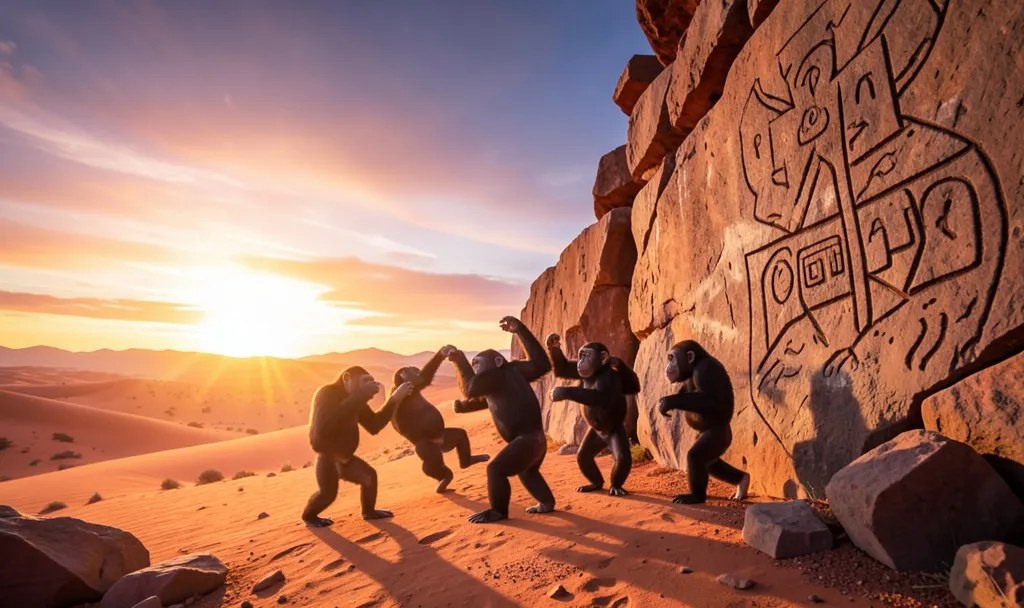
Genes, neurons and culture have had a big influence on how we became human. Each is a loop.
There is an age, and if you have not reached it you will, at which the funerals begin to outnumber the weddings. The death of someone close, which in youth is a rare catastrophe, becomes with the years an uncomfortably regular event; and it comes, oddly, in clusters — three in a season and then a long quiet — the way weddings once clustered, and births after them. It is distressing, of course. But it is also, in a way I did not expect, clarifying. Each loss sets the frailty and the brevity of a single life against something far larger — the long tapestry of everyone who came before and everyone still to come — and reminds you how short a thread any of us gets to be.
And there is something else, which took me longer to see and which I find genuinely consoling. When someone dies, the accumulation they were does not vanish with the body. It lives on — in fragments, unevenly, but unmistakably — in the people who knew them. A turn of phrase you catch yourself using. A standard you keep because they kept it. The run of a horse, or the collapse of a cricket team’s innings, reminds one of the vocal and colourful response of an absent friend. It triggers memories of mistakes made, attitudes hardened and goals achieved. Treasure was a good man. The living mind that has perished goes on, in pieces, inside the minds that remain. That is not a metaphor and it is not wishful thinking; it is, I want to argue, one of the deepest facts about the kind of creature we are.
For a long time we told a different story about what survives us. In the gene’s-eye view made famous by Richard Dawkins, the thing that truly persists — the only thing that is, in a sense, immortal — is the gene: we are its temporary vehicles, built and discarded, while it copies itself down the generations with a sublime indifference to the individuals it rides in. It is a powerful way of seeing, and true as far as it goes. But it is worth remembering that the very book which gave us the selfish gene introduced, in its final chapter, a second replicator — the meme, Dawkins’s own coinage for a unit of culture that likewise copies itself from mind to mind and likewise outlives its carriers. He named it in a single closing chapter. In the half-century since, the evidence has mounted that the afterthought may matter more than the main argument — that what most powerfully shapes the human future is not the slow trickle of the genes but the fast, compounding accumulation of information, and above all of meaning, passed between minds and across the generations. To see why, it helps to notice that evolution did not build one system of inheritance. It built three. That the study of memes has spent fifty years stalled is not evidence against the idea. It is evidence that the search was in the wrong place — among words and ideas, the visible units, rather than in the mechanism beneath them.
Begin with the one you know from the inside. Each of us is, in the most literal sense, an accumulation. A mind is a synaptic matrix — a vast web of weighted connections — that begins near enough unwritten and is inscribed, from the first conditions of infancy to the last of old age, by everything it lives through. We integrate our experiences and our choices, moment upon moment, into an identity that is less a fixed thing than a living curve, still being drawn. And we never draw it alone. From the very start the curve is shaped in company — parents, family, the group, the tribe, the nation — one accumulating mind coupled to others, taking their patterns in and giving its own back. This is why the dead persist in the living: because the coupling was real while it lasted, and the patterns it wrote do not un-write themselves when one party is gone. But the individual mind, extraordinary as it is, is only the middle term of a larger story. It is the second of three loops.
The first loop is the one Darwin found: genetic evolution, the slow one. It works by open-loop variation and selection after the fact — throw up a great range of variants, let the world cull them, let the survivors carry their instructions forward. It is open in a specific and important sense: what an organism learns or achieves in its lifetime cannot be written back into its genes. Open at the level of the individual is what that amounts to. The loop does close — but not through the organism. It closes through the population, and the actuator is death: the bad variant is not corrected, it is removed. Nothing a creature learns the hard way can reach its own instructions. It can only alter the count. The germ line is sealed off from the life of the body — Weismann’s barrier — so that the hard-won wisdom of a life dies with it, genetically speaking. (Epigenetics has since found a little permeability in that wall, but the wall stands.) This openness is a feature, not a flaw; it keeps the genome from lurching after every passing circumstance. But it exacts a price. Genetic evolution moves at the pace of generations, far too slowly to help an animal cope with a world that can change within an afternoon.
The second loop is evolution’s answer to that slowness: the neural loop, the fast one. Rather than wait for the germ line to stumble on a better response over ten thousand years, build an organism that can change itself within a single lifetime — that can accumulate the consequences of its own experience and act differently tomorrow for what happened today. This is a closed loop, feeding an animal’s own outcomes back into its own behaviour, running in parallel with the slow genetic one and enormously faster. What it changes is who pays for the lesson. In the first loop the price of learning is the death of the animal that got it wrong; in the second, maybe only its discomfort. And it is ancient. Within-lifetime learning is at least half a billion years old: Eric Kandel won a Nobel Prize for showing that the sea slug Aplysia, with a nervous system of some twenty thousand neurons, already learns and remembers through the strengthening of synapses. The basic operation of this loop is that deeply conserved, because it works. What has changed across the aeons is not the operation but the scale and reach of the machinery that runs it.
The third loop is the one that made us. It is not, at bottom, a new mechanism but a special case of the second — the same neural machinery of accumulation, turned to a new use. What makes it a loop in its own right is that its information is symbolic and external, and that it compounds not within a lifetime but across the generations. One mind’s hard-won accumulation, instead of dying with it, is passed to another and kept; and the next mind starts not from nothing but from there. Not indiscriminately. The receiving mind is a particular accumulation of prior encounters, and what it keeps is whatever activates its existing structure and survives. This hints at the mechanism memetics was missing.
We are not the only animals that run this loop, and saying so locates exactly what is special about us — and what is not. Killer whales pass down hunting techniques and vocal dialects that differ from pod to pod, learned and not born. Chimpanzee troops keep local tool-use traditions — a particular way of cracking a nut, of fishing for termites — that vary between neighbouring groups for no reason written in their genes. New Caledonian crows in different valleys maintain their own tool designs. In each case a third loop is turning: knowledge accumulating in a group and outliving the individuals who held it, carried forward by imitation rather than by inheritance. What sets us apart is not that we have the loop; it is that language threw its reach and its bandwidth open by orders of magnitude, turning a real but slender channel into the engine of everything we have built. The mechanism is old and widely shared. The volume it runs at is ours alone.
And in our own line the loop was running long before language — faintly, through the older channels: music, dance, ritual, the image scratched on a cave. It idled in that form for tens of thousands of years. Then something switched it to full power.
That something was language, and it presents a genuine puzzle — the one that has troubled the study of cultural evolution since Dawkins named the meme. The old assumption was that we evolved for language. But language changes far faster than genes can track, and there has not been time for machinery that specific to evolve. More likely it ran the other way: language grew inside the cultural loop, on hardware already there, building on the substrate mechanisms the older channels had left us — resonance, music, schema. That is why we are born without language and yet equipped for it: language adapted to the genetic structures we had.
The upgrade, when it came, was not better copying, and not a sharper definition of what gets copied. Language was not selected for any particular thing it let our ancestors say, nor for the fidelity with which it let us mimic each other. It was selected because it was a qualitative upgrade to the machinery of accumulation itself — the threshold at which the third loop came fully on. A threshold crossed by a slowly assembled, many-part system, after which something new was running. And what was running had a remarkable property: it compounded. Each generation could now inherit a richer store of accumulated meaning than the one before, and so began from a higher base, and so added more, and passed on more again — the store growing faster the larger it grew. The anthropologist Joseph Henrich has traced the consequence across the record: what carried a people forward was never any single piece of knowledge but the accumulation process itself. And the mechanism does not need the threshold in order to explain itself. Any small improvement in social learning pays off at once, in the life of the individual who has it, and pays off in proportion to how much useful know-how the surrounding group already holds — so better learners make a richer store worth having, and a richer store makes better learners worth being. The ratchet turns with a real advantage at every step. The threshold describes what came out, not what drove it. And that process runs one mind at a time — each receiving mind keeping what takes hold in it and letting the rest go. Over generational time that compounding advantage is not slight. It is decisive. Not for what language says, but for the runaway engine it switches on.
Once the loop was running, its whole history has been the turning of two dials: how long an accumulation can last, and how far it can reach. Spoken language alone held the store for as long as living memory and the oral tradition could carry it — perhaps ten or twenty generations, and lossy at that. Writing broke the limit. A pattern committed to clay or paper no longer died with the mind that held it; the psychologist Merlin Donald calls this externalised memory the decisive transition in human cognition, and so it is — an idea set down by Aristotle is available to any literate mind in any century since. The time-constant of the cultural loop leapt from decades to millennia. Printing then worked the other dial, throwing the bandwidth of transmission from hundreds of copies to millions. The internet threw it again, to billions at once. And in the last few years we have built the strangest extension yet — machines that have swallowed the accumulated written store whole and will hand you any part of it on request. Each of these was the same move: tighten the loop, widen the channel, lengthen the reach, and let the compounding run faster. The neural loop has been running for half a billion years and the cultural loop for a sliver of that, and we are living through its sharpest bend.
Each loop is an information process that follows the second law of thermodynamics. None of them comes from it. Genetics obeys the physics; the physics does not tell you what the sequence says. It governs the medium, not the message — and the same holds for a life, and for a civilisation. Entropy has no preference, no aim and no valence. It supplies the conditions and the arrow of time. What we accumulate in our minds, the morals, the ethics, is not neutral at all.
The balance has tipped from the first loop to the third, and it is worth dwelling on how completely. Picture the encounter we have rehearsed in a thousand stories — contact, at last, with a mind from another world — and notice what we would actually want to know. Not, in the first instance, how they had evolved: which chemistry they ran on, what their equivalent of DNA looked like, which limb of some alien tree of life they had climbed. That would be a footnote. What we would strain to learn is what they had accumulated — what they had come to understand and to value, what they had made and thought across their own long history, whether their own third loop had carried them anywhere we might recognise. We would be far less curious about their genes than about their libraries. Which is only the claim of this essay thrown up onto a cosmic screen: in the end a mind is defined not by the evolutionary road that produced it but by the accumulation it arrives carrying.
You can watch the same principle at work much closer to home, on nothing more exotic than the scale of human history. Socrates wrote not a single word — no book, no scroll, no line in his own hand — and he has been dead for two and a half thousand years. Yet he is, in a way that ought to give us pause, still alive: still putting his questions to every student who meets him, still turning over arguments in minds that did not exist when he drank the hemlock. He survived because his way of thinking resonated so strongly in the people around him that one of them, Plato, carried it into writing and set it running down the third loop, from one prepared mind to the next, for a hundred generations. The man is long gone; the accumulation he was goes on, and works, and changes people, now. That is not a manner of speaking. It is the loop seen over the longest human span we have.
And it is the same fact, on an intimate and far more wrenching scale, that we half-know at a graveside. Set a single human life against that half-billion-year accumulation and it is heartbreakingly brief — a thread, as I said, in an immense tapestry. But the tapestry is the point, and here is what steadies me. The genes of the person we have lost may or may not travel on; that lottery was settled long ago, and it is not the main event here. What travels on, and travels first, is the other inheritance — the accumulated meaning they built and spent a life refining, which passed, through every ordinary coupling of minds, into the people around them, and will pass again from those people to others who will never know whose it first was. The way they worked, the things they would not stand for, the joke, the tune, the exact quality of their attention: these are threads in the third loop now, out of the body and into the culture, revised and recombined and carried forward. We are the animal that learned to put its accumulation somewhere the grave cannot reach.
That is what the three loops amount to, and the reason the last of them matters most in the age we are living through. The slow genetic loop made the animal. The fast neural loop let the animal learn. And the third loop — culture, switched to full power by language and amplified ever since by every technology of memory we have built — let what one mind learned outlast the mind, and gather, and compound, until the distance between us and our ancestors became the whole of civilisation. Every child born now walks, unasked, into the accumulated inheritance of all of it, and takes up the work of carrying it a little further before handing it on. What they inherit is not neutral, and neither is what they add. The people we bury are not wholly gone. They have simply moved into the loop that does not end with any of us — the one we are all, still, helping to draw.
Note on method. The ideas here are mine, and have been the subject of a human quest you can follow at www.integraloflife.com. As an engineer I am comfortable having them written with an LLM in support, as much as you presumably are about the software that helped design the aircraft you fly in.